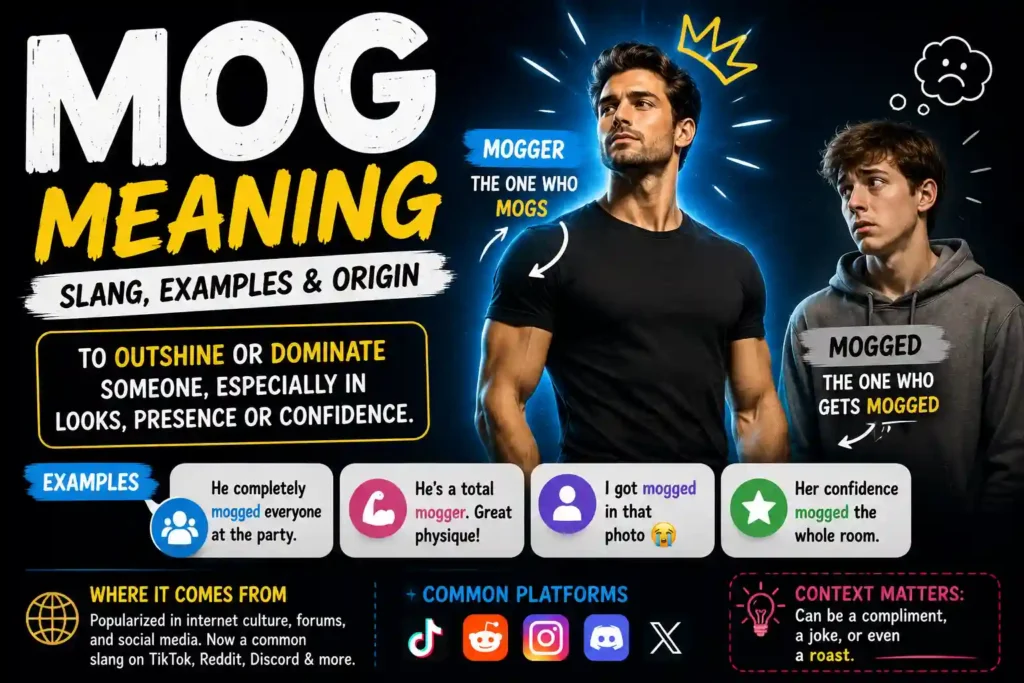
The word “mog” has become increasingly common across TikTok, Reddit, Instagram, X, Discord, and other online communities. You might see comments like “he mogged everyone,” “you got mogged,” or “frame mogged” without any explanation, leaving the meaning unclear if you’re unfamiliar with modern internet slang.
In today’s online conversations, mog usually describes someone who noticeably outshines or dominates another person in terms of appearance or physical presence. While the slang has roots in niche internet communities, it has spread into mainstream social media and is now used both seriously and humorously.
This guide explains the mog meaning, how people use it online, where it came from, what related terms like frame mogged meaning refer to, and how it differs from the acronym M.O.G.
Mog Meaning at a Glance
| Term | Meaning |
| Mog | To noticeably outshine or dominate someone, usually based on physical appearance or overall presence. |
| Mogged | A person has been clearly outperformed or overshadowed by someone else. |
| Mogging | The act of making another person appear less attractive or less impressive through comparison. |
| Primary Usage | Internet slang, social media, memes, and online discussions. |
| Common Platforms | TikTok, Reddit, Instagram, X, Discord, and YouTube. |
Although the word often relates to looks, it isn’t limited to attractiveness alone. Depending on the conversation, it may refer to height, body build, facial features, confidence, or overall presence.
Love To Read More DTM Meaning Explained: Complete Guide to Text, IOM & GIS
How “Mog” Is Used in Today’s Internet Slang
The modern slang meaning of mog, or simply the mog meaning most people encounter online, revolves around comparison. Rather than describing someone independently, it compares two or more people and suggests that one person clearly stands out over the others.
Unlike traditional compliments, the term usually implies that the difference is obvious enough for everyone to notice.
The Core Meaning Behind “Mog”
In internet slang, mog means to surpass someone so noticeably that the comparison feels one-sided. The person doing the “mogging” is viewed as having a stronger appearance, greater physical presence, or a more striking overall look.
The comparison is often based on visual traits such as:
- Facial features
- Height
- Body frame
- Physique
- Style
- Confidence
- Overall presence
Because the term focuses on comparison rather than absolute attractiveness, someone can be described as “mogging” another person even if both are generally considered attractive.
Over time, the slang has expanded beyond appearance in casual conversations. Some users now use it humorously to describe someone outperforming another person in almost any situation. Even so, appearance remains the most common context.
Explore Related Slang Terms CTFU Meaning: What It Means in Text & Social Media
What “Mogged” and “Mogging” Mean
As the slang became more popular, several variations naturally emerged.
Mogged is the past-tense form. It describes the person who has been overshadowed in a comparison.
For example, online discussions might say that someone “got mogged” after standing next to another person whose appearance drew significantly more attention.
Mogging refers to the act itself. It describes one person clearly outshining another, whether intentionally or not.
These variations are common in:
- Meme captions
- Photo comparisons
- Short-form videos
- Reaction posts
- Discussion threads
- Livestream chats
You’ll also encounter phrases like:
- Face mogged
- Height mogged
- Frame mogged
- Brutally mogged
Each variation focuses on a specific type of comparison rather than changing the overall meaning of the slang.
Read More What Does WYF Mean? Text, Snapchat & Online Slang Explained
Is Mog Positive, Negative, or Both?
The answer depends on context.
Sometimes mog is used as a compliment. Calling someone a “mogger” or saying they “mog everyone” suggests they have an exceptionally strong appearance or commanding presence.
In other situations, the word carries a negative tone because it highlights someone else’s perceived shortcomings. Saying a person “got mogged” often implies they looked noticeably less impressive when compared with someone else.
Social media has also turned the term into a joke. Many creators exaggerate the idea of “mogging” for comedic effect, applying it to fictional characters, celebrities, athletes, pets, or even everyday objects. In these cases, the word is used more for entertainment than as a serious judgment.
Because tone varies widely, it’s important to consider the surrounding conversation rather than assuming the term is always complimentary or insulting.
Where You’ll Commonly See the Word “Mog”
The rise of short-form content has helped mog move beyond niche internet communities into everyday online language. Today, the slang appears across multiple platforms where users regularly compare photos, videos, or public figures.
TikTok
TikTok is one of the biggest reasons the term has become mainstream. Users frequently include “mog” in edits, transformation videos, ranking clips, and reaction content. Comments often debate who “mogged” whom based on appearance, style, or confidence.
On Instagram, the slang appears beneath fashion posts, fitness content, and celebrity photos. It is commonly used in comments comparing two people or reacting to striking images.
Reddit communities discussing internet culture, fitness, fashion, and appearance often use the word in longer conversations. Here, the meaning is usually explained in greater detail, making it easier to understand how the slang developed and how people interpret it.
Discord
Discord servers dedicated to memes, gaming, anime, and social discussions frequently use “mog” as casual slang. Because conversations move quickly, the word is often used without explanation, assuming everyone in the community already understands it.
X (Formerly Twitter)
On X, the term commonly appears in replies to viral photos, celebrity posts, and trending topics. Users often make quick comparisons, using “mogged” as shorthand for someone who clearly stands out over another.
YouTube
YouTube Shorts and long-form commentary videos have also helped popularize the slang. Creators discussing internet trends, meme culture, fitness, or celebrity comparisons often reference “mogging,” while viewers continue the conversation in the comments.
Regardless of the platform, the core idea stays the same: mog is a comparison term used to suggest that one person noticeably outshines another in appearance or overall presence. The tone may be serious, playful, or exaggerated, but the underlying meaning remains consistent.
Discover similar internet slang Snow Bunny Meaning: Simple Guide to Every Common Definition
What Does “Frame Mogged” Mean?
Among the many variations of the slang, frame mogged is one of the most common. If you’ve seen comments like “he got frame mogged” or “she frame mogged everyone,” the discussion is specifically about a person’s body structure rather than their face or clothing.
In simple terms, frame mogged meaning refers to someone being outmatched because another person has a naturally more noticeable or imposing body frame.
What “Frame” Refers To
In online slang, a frame is the overall structure of a person’s body. It isn’t the same as weight or muscle mass. Instead, it describes the physical foundation that affects how someone appears at first glance.
People using this term may be referring to characteristics such as:
- Shoulder width
- Overall body proportions
- Bone structure
- Height in relation to body shape
- Natural physical build
Because these traits are largely structural, discussions about “frame” usually focus on features that aren’t easily changed through clothing or fitness alone.
Why “Frame Mogged” Is Used Online
The phrase is often used when comparing two people standing next to each other. Even if both individuals are fit or well-dressed, viewers may say one “frame mogged” the other if their body proportions appear more balanced, broader, or more visually striking.
You’ll commonly see this phrase in:
- Celebrity comparisons
- Fitness discussions
- Fashion content
- Transformation videos
- Meme edits
- Social media comment sections
Like many internet slang terms, frame mogged is often exaggerated for humor. A dramatic comparison doesn’t necessarily reflect an objective assessment—it may simply be part of the playful language common in online communities.
It’s also worth remembering that beauty and attractiveness are subjective. While some online discussions treat these comparisons as definitive, real-world opinions vary widely.
Other Types of Mogging You May See Online
As the slang evolved, users began attaching “mogged” to different physical traits. These variations all follow the same basic idea: one person is perceived as noticeably outperforming another in a specific area.
Face Mogged
Face mogged refers to comparisons based mainly on facial appearance.
People may use the phrase when discussing features such as facial symmetry, jawline, eyes, skin, or overall facial attractiveness. The emphasis is on the face rather than height or body shape.
Height Mogged
When someone says a person was height mogged, they’re talking about stature.
The phrase suggests that another person’s height made them appear more dominant or visually impressive during a comparison. It frequently appears under celebrity photos, sports content, and group pictures where height differences are easy to notice.
Body or Physique Mogged
This variation focuses on muscle definition, fitness, or overall physique.
Unlike frame mogged, which refers to natural body structure, physique mogged generally relates to body composition, conditioning, or muscular development.
Brutally Mogged
Adding “brutally” simply increases the intensity.
Instead of suggesting a close comparison, it implies that the difference between two people was so obvious that there was little room for debate. In meme culture, this expression is often exaggerated for comedic effect rather than used as a serious evaluation.
Where the Term “Mog” Came From
Although mog feels like a recent social media trend, its roots go back to older internet communities where appearance, fitness, and self-improvement were frequent discussion topics.
Over time, the term moved beyond those niche spaces and became part of mainstream online vocabulary.
Early Internet Communities
The slang gained traction in online forums where users discussed physical appearance and compared features such as height, facial structure, and body proportions.
Within these communities, “mog” became shorthand for one person clearly surpassing another in a visual comparison. Because the word was concise and easy to understand, it spread quickly through discussions and memes.
Some of these communities were connected to looks-focused subcultures. When mentioning this history, it’s important to understand that the slang itself is now used much more broadly than its original context.
How the Slang Became Mainstream
The popularity of TikTok, Instagram Reels, YouTube Shorts, and meme pages introduced mog to a much larger audience.
Creators began using the word in:
- Celebrity edits
- Before-and-after transformations
- Fashion comparisons
- Fitness videos
- Reaction content
- Viral memes
As more users encountered the term, they adopted it in everyday online conversations, often without knowing where it originally came from.
Today, many people use mog, mogged, and mogging simply as humorous internet slang for comparing appearance or presence, with little awareness of the term’s early history.
Does “M.O.G.” Mean the Same Thing?
Not necessarily. Although the spellings look similar, M.O.G. and mog are not automatically interchangeable.
The slang word mog is typically written in lowercase and refers to someone outshining another person in appearance or overall presence.
By contrast, M.O.G. is an acronym. Its meaning depends entirely on the context in which it’s used.
For example, M.O.G. meaning may differ across industries, organizations, or technical fields because acronyms often have multiple definitions. Without surrounding context, there isn’t a single universally accepted expansion for M.O.G.
When you encounter the term:
- Lowercase “mog” usually points to internet slang.
- Uppercase “M.O.G.” usually signals an acronym that should be interpreted based on the subject or industry being discussed.
Checking the surrounding conversation is the easiest way to determine which meaning is intended and avoid confusing the two.
Similar Slang Terms That People Confuse With “Mog”
Because mog has become more popular, it’s often confused with other Gen Z and internet slang. While these terms all involve opinions or comparisons, they don’t mean the same thing.
Mog vs. Cooked
Cooked usually means someone is in a hopeless situation or has made a serious mistake. It doesn’t specifically refer to appearance.
Mog vs. Aura
Aura describes the confidence, charisma, or presence a person gives off. Someone with a strong aura might attract attention even without being the most conventionally attractive person.
Mog vs. Glow Up
A glow up is a noticeable improvement in someone’s appearance, style, or confidence over time. In contrast, mog describes a comparison between people rather than a personal transformation.
Mog vs. Rizz
Rizz refers to charm or flirting ability. Someone can have excellent rizz without necessarily “mogging” other people based on appearance.
Understanding these differences helps you interpret online conversations more accurately, especially when multiple slang terms appear in the same discussion.
Common Misunderstandings About “Mog”
As with many viral slang terms, misconceptions are common. Here are a few of the biggest ones.
It Doesn’t Always Mean Someone Is More Attractive
Although appearance is the most common context, “mogging” isn’t limited to conventional attractiveness. People may use the word to compare height, confidence, posture, fashion sense, or overall presence.
It Isn’t a Scientific Rating
Social media discussions sometimes present “mogging” as though attractiveness can be measured objectively. In reality, these comparisons are based on personal opinions, trends, and internet humor rather than any accepted standard.
It’s Often Used as a Joke
Many comments saying someone “got mogged” are intentionally exaggerated. Meme culture thrives on dramatic language, so not every use of the term should be taken literally.
The Meaning Depends on Context
One reason the mog meaning can seem confusing is that the same word can have different meanings depending on where you encounter it. In most social media conversations, mog refers to appearance-based comparisons. If you see M.O.G. written in capital letters with periods, it’s more likely to be an acronym than internet slang.
When the Word “Mog” May Not Be Appropriate
Like many internet expressions, mog works best in informal conversations where people already understand modern online slang.
It may not be suitable in:
- Professional communication
- Academic writing
- Formal presentations
- Workplace discussions
- Conversations with people unfamiliar with internet culture
Because the term often compares people’s appearance, it can also come across as insensitive or overly critical if used carelessly. Before using it, consider your audience and whether the comparison adds anything constructive to the conversation.
Conclusion
The mog meaning used across today’s internet is fairly straightforward once you understand the context. In most cases, it describes someone noticeably outshining another person in appearance, physical presence, or another visible characteristic. Variations like mogged, mogging, and frame mogged all build on this same idea while focusing on different types of comparisons. Meanwhile, M.O.G. written as an acronym is a separate concept whose meaning depends on the field or discussion. Recognizing these differences makes it much easier to follow conversations on TikTok, Reddit, Instagram, Discord, X, and other social platforms where the slang has become part of everyday online language.