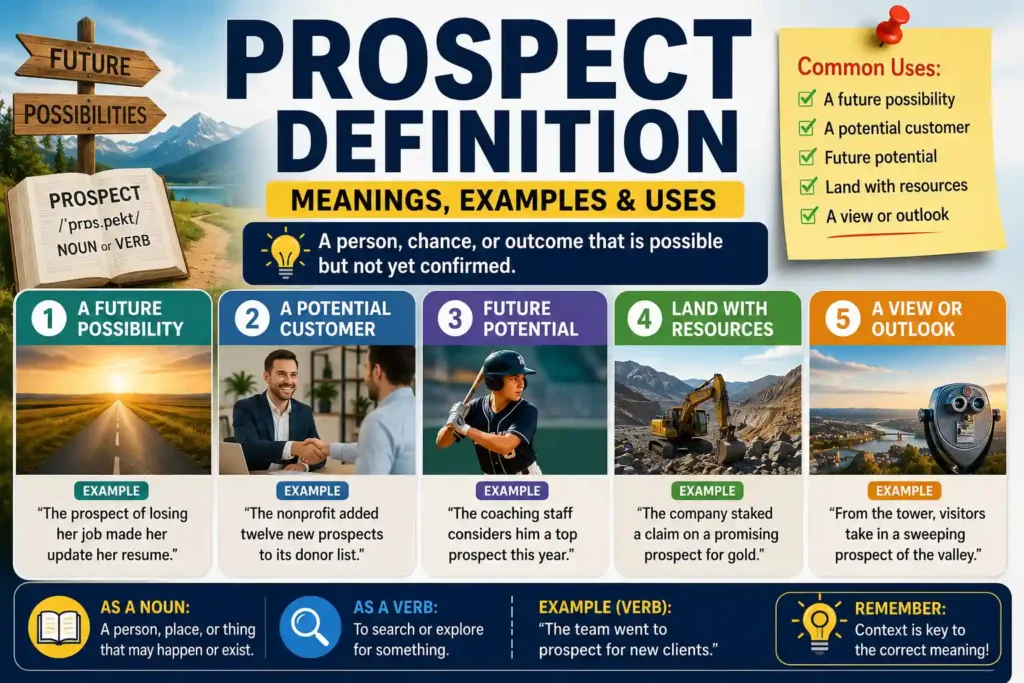
The prospect definition can seem confusing because the word appears in sales meetings, geology reports, and everyday conversation, but it doesn’t always mean the same thing. Sometimes it points to a person. Other times it describes a chance or an outlook. This guide walks through every major dictionary sense of “prospect,” shows how each one plays out in real sentences, and clears up the confusion between related terms like “prospective” and “prospecting.”
Quick Answer
| Word | Prospect |
| Pronunciation | /ˈprɒs.pekt/ (noun and adjective use), /prəˈspekt/ (verb use) |
| Part of Speech | Noun or verb |
| Simple Meaning | A person, chance, or outcome that is possible but not yet confirmed |
| Common Uses | A future possibility, a potential customer or recruit, and a site being explored for resources |
What Does Prospect Mean?
“Prospect” carries five distinct senses, and most confusion about the word comes from mixing them up. Below is each one broken down separately, since dictionaries usually list them together in a single dense entry that’s hard to read at a glance. Understanding the prospect definition becomes much easier once you see how each meaning applies in a different context.
1. A Future Possibility or Expectation
This is the most common everyday sense. It describes something that hasn’t happened yet but seems likely, whether that’s a good outcome or a bad one. It shows up constantly in casual speech, news writing, and business forecasting whenever someone is describing what might come next rather than what has already occurred. For example: “The prospect of losing her job made her update her resume.”
2. A Likely Customer or Client
In this sense, a prospect is a specific person or organization considered a realistic candidate to buy something, join something, or sign up for something. It’s used heavily in sales, marketing, fundraising, and recruiting, anywhere an organization needs to describe someone who hasn’t committed yet but fits the profile of someone who might. For example: “The nonprofit added twelve new prospects to its donor outreach list.”
3. Someone With Future Potential
Beyond sales, “prospect” also describes a person being evaluated for what they might become, rather than for what they’ve already accomplished. This sense is common in sports scouting, college recruiting, and hiring for entry-level roles, where the whole point is judging upside instead of track record. For example: “The coaching staff considers him one of the top prospects in the league this year.”
4. Land Believed to Contain Valuable Minerals
In mining and geology, a prospect is a specific tract of land or site being explored because it’s believed to hold gold, oil, or other valuable resources, though nothing has been confirmed yet. Geologists and mining companies use this term before any extraction begins, during the exploratory phase. For example: “The company staked a claim on a promising prospect in the northern hills.”
5. An Older Meaning: A View or Outlook
Centuries ago, “prospect” most commonly referred to a physical view over a landscape, such as a scenic outlook from a hill or window. This sense still appears occasionally in formal or literary writing, but it’s largely archaic in everyday modern English. For example: “The estate’s brochure described a fine prospect of the valley from the west terrace.”
Prospect as a Noun
Grammatically, “prospect” behaves differently depending on which sense is in play. In the “person” and “land” senses, it’s a countable noun: you can say “a prospect,” “three prospects,” or “the best prospect.” In the “possibility” sense, it usually appears in the pattern “the prospect of” followed by a noun or a verb ending in “-ing,” as in “the prospect of rain” or “the prospect of moving.” It also pairs naturally with evaluative adjectives, producing common phrases like “a bright prospect” or “a poor prospect,” which describe how promising or unpromising something looks.
Prospect as a Verb
As a verb, “prospect” conjugates regularly: prospect, prospects, prospecting, prospected. It almost always pairs with the preposition “for,” as in “prospect for gold” or “prospect for new clients,” and it always implies an active search rather than a passive expectation. One detail worth noting: the stress shifts when the word is used this way, moving from PROS-pect (noun) to pro-SPECT (verb), which is a common pattern in English words that function as both. For example: “The company sent a team to prospect for lithium deposits.”
Prospect in a Sentence
The table below shows the same word shifting meaning depending on the sentence around it.
| Context | Example Sentence |
| Future possibility | “None of us liked the prospect of driving through the storm.” |
| Likely customer | “Our sales rep followed up with the prospect three times before closing the deal.” |
| Future potential | “The scouting report called him the top prospect in this year’s draft class.” |
| Mining and geology | “Investors were cautious until drilling confirmed the prospect held real reserves.” |
| Older, literary sense | “From the tower, visitors take in a sweeping prospect of the countryside.” |
Different Meanings by Context
The core idea behind “prospect” stays the same across fields, but the emphasis shifts depending on where it’s used. Although the prospect definition stays rooted in possibility and potential, its exact meaning changes depending on the field in which it’s used.
- Everyday English: A general hoped-for or feared outcome, as in “the prospect of a day off.”
- Business: The outlook for a company or industry, as in “prospects for the retail sector look weak this quarter.”
- Sales: A specific person or organization qualified as a realistic potential buyer, distinct from an unqualified lead.
- Sports: A young or unproven athlete considered likely to succeed at a higher level, a term used constantly in draft and recruiting coverage.
- Education: A student’s likely outcomes, such as admission chances or career prospects after graduation.
- Finance: An investment, deal, or asset still being evaluated for its likely risk and return.
- Medicine: A patient’s expected course of recovery or long-term outlook.
- Mining and Geology: The land or site under exploration, as covered in the definitions above.
Prospect vs. Prospective
These two words are related but not interchangeable. “Prospect” is a noun (or verb) that names the person or possibility itself. “Prospective” is an adjective that describes something expected or likely to happen, and it always modifies another noun. You would say “she is a prospective buyer,” not “she is a prospect buyer.” Similarly, you’d say “the prospect toured the property” but not “the prospective toured the property,” since “prospective” needs a noun to attach to. A simple way to remember the difference: if the word stands alone as the subject, use “prospect.” If it’s describing another noun, use “prospective.”
Prospect vs. Prospectus
A prospectus is a formal legal document, most often used when a company offers stock or a fund offers shares to investors. It lays out the risks, financial details, and terms of the investment. While both words share the same Latin root, “prospectus” refers specifically to this written disclosure document, not to a person or general possibility. Someone reading a prospectus before investing is doing research on a specific, defined offering, which is a much narrower use than the everyday sense of “prospect.”
Prospecting Explained
Prospecting is the act of searching for prospects, and the term applies in both the mining sense and the business sense. In mining and geology, prospecting means physically searching land for signs of valuable minerals, often using tools like core samples and geological surveys. In sales, prospecting means researching, identifying, and reaching out to people or companies who might need what you’re selling. Cold calling, cold emailing, and networking events are all common prospecting methods. The goal in both cases is the same: turn an unknown possibility into a confirmed opportunity.
Common Phrases and Collocations
Certain word pairings show up so often that they’re worth learning as set phrases rather than building sentence by sentence. Career prospects and future prospects both describe how promising someone’s path looks going forward. Bright prospects and good prospects signal a positive outlook, while poor prospects and bleak prospects signal the opposite. Employment prospects is common in economic and policy writing, referring to how easy or hard it is for a group of people to find work. Business prospects and sales prospects both appear constantly in commercial writing, though the first usually refers to a company’s outlook and the second to individual potential customers. Recognizing these pairings helps with both reading comprehension and natural-sounding writing.
Synonyms for Prospect, Organized by Meaning
Because “prospect” covers several distinct ideas, a single synonym list can be misleading without grouping. Synonyms depend on the meaning of prospect in a sentence. For a future possibility, close alternatives include chance, likelihood, outlook, and expectation. In sales or recruitment, similar words include lead, candidate, and potential client. As a verb, prospect is closest in meaning to explore, search, and scout. Picking from the right group avoids swapping in a word that technically means something adjacent but doesn’t fit the sentence.
Contrasting Terms
There’s no single word that functions as a true opposite of “prospect,” since it spans a noun, a verb, and several specialized meanings. The closest contrasts depend on which sense is in play: for the “possibility” sense, words like certainty or impossibility point the other direction, since they remove the uncertainty that defines a prospect. For the “sales lead” sense, the practical opposite is simply a dead lead or disqualified contact, someone who has been ruled out rather than confirmed as a fit.
Origin and Historical Meaning
“Prospect” traces back to the Latin word “prospectus,” which combines “pro” (forward) and “specere” (to look). That word formation is where the modern spelling and pronunciation come from. But the meaning tells its own story separately from the word’s building blocks. For most of the term’s history in English, “prospect” primarily meant a physical view, the kind of scenic outlook you’d get from a hilltop or a window facing open land. Writers used it constantly to describe landscapes and vistas.
Only over later centuries did English speakers extend that literal act of looking outward into the more abstract idea of looking ahead in time, toward something that might happen. That shift from a view you can see to an outcome you can only anticipate is how the same word ended up describing scenery, sales leads, and unexplored mineral deposits. Knowing the history behind the prospect definition also explains why the word developed so many different meanings over time.
Conclusion
The full prospect definition covers more ground than most people expect from a single word: a future possibility, a likely customer, someone with untapped potential, unexplored mineral land, and an older sense meaning a scenic view. None of these meanings is more “correct” than another. Context decides which one applies, whether that context is a sales pipeline, a scouting report, a geology survey, or an old description of a landscape. When the word shows up in a sentence, the fastest way to pin down its meaning is to ask what kind of uncertainty it’s pointing at: a person, a place, or a possible future. That question, more than any dictionary entry, is the real key to understanding “prospect.”
Frequently Asked Questions
Is a prospect the same as a lead?
No. A lead is any contact with unconfirmed interest, while a prospect has been qualified as a realistic potential buyer based on factors such as fit, budget, or expressed interest.
Can “prospect” be used as an adjective?
Not typically. The adjective form is “prospective,” as in “prospective client” or “prospective employee.” The word “prospect” is primarily used as a noun or a verb.
What’s the difference between prospecting and networking?
Prospecting is a targeted process of identifying and reaching out to people who match a specific customer profile. Networking is broader and focuses on building professional relationships that may eventually create business opportunities.
Does “prospect” always relate to sales?
No. Although it’s common in sales, the word also refers to future possibilities, job opportunities, geological exploration, investment potential, and medical outlooks, depending on the context.
What is a good prospect?
In sales, a good prospect is someone who fits the target customer profile, has a genuine need for the product or service, and is likely to make a purchase. Outside of sales, a good prospect simply refers to a favorable or promising possibility.
What is a future prospect?
A future prospect is a possible outcome or opportunity that has not happened yet but appears likely or worth expecting. Examples include career prospects, business prospects, or the prospect of economic growth.
Can “prospect” mean opportunity?
Yes, in some contexts. Both words refer to something that could happen in the future. However, “opportunity” usually suggests a chance to take action, while “prospect” refers more broadly to a likely possibility or expected outcome.
Can “prospect” refer to a person?
Yes. In fields such as sales, recruiting, and sports, a prospect is a person who is considered a potential customer, employee, or athlete with future potential.
Is “prospect” a positive word?
Not necessarily. The word itself is neutral because it describes a possibility rather than a guaranteed outcome. Whether it has a positive or negative meaning depends on the surrounding context, such as “bright prospect” or “bleak prospect.”