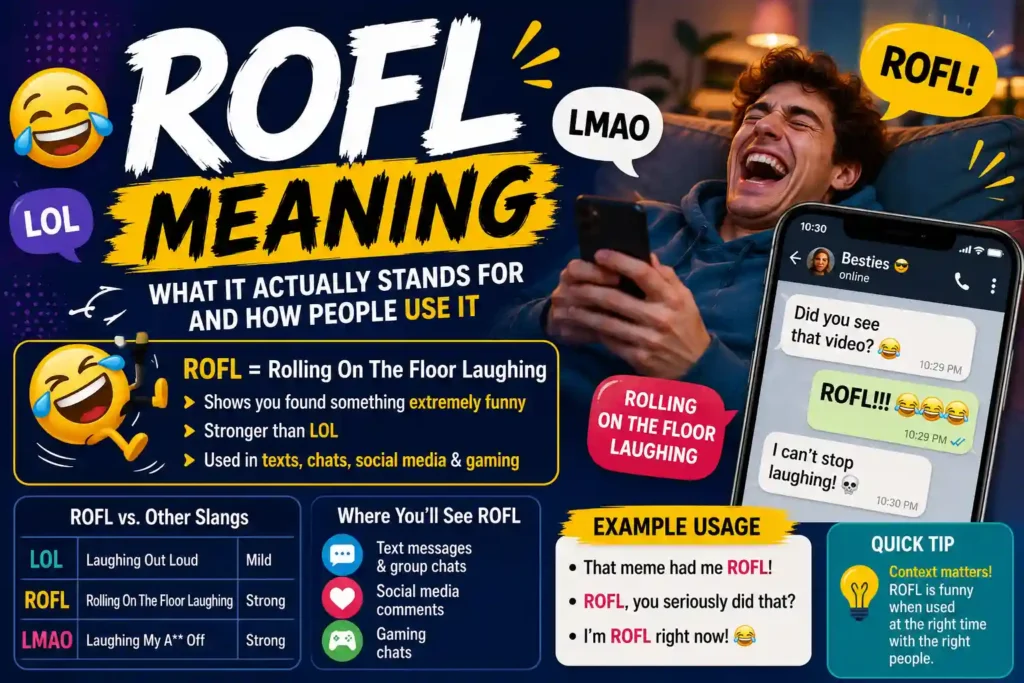
ROFL stands for “Rolling On the Floor Laughing.” The rofl meaning is simple on the surface someone found something so funny they’re picturing themselves cracking up on the ground but how it lands depends heavily on where it shows up and who’s typing it. Used in a group chat about a dumb meme, it reads as genuine amusement. Dropped into a reply about someone’s bad day, it can come across as mocking. That gap between the literal definition and the real-world tone is what most guides skip, and it’s the part worth actually understanding.
What ROFL Stands For
ROFL is an initialism, meaning you say the letters individually (R-O-F-L) rather than pronouncing it as one word. It expands to “Rolling On the Floor Laughing” and signals a stronger reaction than a plain “lol” something closer to genuine, can’t-hold-it-in laughter rather than a polite acknowledgment that a joke landed.
A less common variant, ROTFL, adds “the” (“Rolling On The Floor Laughing”). It shows up occasionally in older forum posts and message boards but has mostly faded in favor of the shorter ROFL. Either way, the rofl meaning stays the same: exaggerated, physical laughter, not a mild chuckle.
Where ROFL Came From
ROFL belongs to the same generation of internet shorthand as LOL and LMAO, all of which trace back to early text-based chat: bulletin board systems, Usenet, and Internet Relay Chat (IRC) in the 1980s and 90s. Typing was slow, connections were slower, and abbreviating an emotional reaction was faster than spelling it out. LOL came first as the baseline “this is funny” response. ROFL developed as an escalation a way to signal that “lol” undersold how funny something actually was.
Through the 2000s, ROFL spread from chatrooms into instant messaging, then into forums, comment sections, and eventually social media captions and gaming chat. Its usage has declined somewhat compared to LOL and LMAO, but it hasn’t disappeared. It still reads as a slightly more emphatic, slightly more old-school way of saying “I’m actually laughing.”
Is ROFL Meant to Be Said Out Loud?
Not really. Like most internet acronyms of its era, ROFL was built for text, not speech. When people do say it aloud, they usually either spell out the letters or read it as a made-up word (something like “raff-ul”), often as a joke about how absurd it sounds spoken. You won’t hear it in normal conversation the way you might hear someone say “lol” as a spoken filler word.
ROFL vs. LOL vs. LMAO: What’s the Actual Difference
These three get used almost interchangeably, but there’s a rough intensity ladder among them.
| Term | Full Form | Relative Intensity | Typical Use |
| LOL | Laughing Out Loud | Mild often just acknowledges a joke | Casual, frequent, sometimes used without real laughter |
| ROFL | Rolling On the Floor Laughing | Strong implies a bigger reaction | Reserved for things that are genuinely funny |
| LMAO | Laughing My A** Off | Strong, more informal/crude tone | Similar strength to ROFL but blunter |
The practical difference: “lol” gets typed so often that it’s lost most of its literal meaning people use it to soften a message or show they’re not being serious, not necessarily because they’re laughing. ROFL, because it’s used less frequently, tends to still mean what it says. If someone sends ROFL instead of lol, that’s usually a signal they found something more than mildly amusing.
What Does ROFL Mean in Texting, Specifically
What does ROFL mean in texting versus, say, a formal email? In texting, ROFL works as a quick, high-energy reaction to something funny a screenshot, a story, a voice memo gone wrong. It’s short enough to type one-handed and expressive enough to replace a longer sentence like “that’s genuinely hilarious.”
A few realistic examples:
- “just tripped in front of my entire class ROFL”
- “ROFL wait he actually said that to his boss??”
- “sent you a video, ROFL you have to watch this”
In group chats and social media captions, ROFL often pairs with an emoji (😂, 💀) to reinforce the reaction. In gaming chat, it tends to show up after a chaotic or unexpected moment a bad play, a glitch, a teammate doing something ridiculous.
Does Tone Change Based on Context or Who’s Sending It
The meaning of ROFL doesn’t change depending on who sends it there’s no hidden or gendered version of the term. What does change is tone, and that’s driven by relationship and context, not by the sender’s identity. Between close friends, ROFL usually reads as warm and teasing. From someone you don’t know well, it can read as more neutral or even a little try-hard if it’s overused. The acronym itself stays the same; what shifts is how much goodwill is already built into the conversation.
When ROFL Can Sound Rude or Sarcastic
Context is what turns “ROFL” from genuine to biting. A few situations where it lands badly:
- Responding to bad news. “ROFL that sucks” reads as dismissive, even if that’s not the intent.
- Reacting to someone’s mistake at their expense. “ROFL you actually forgot?” can feel like mocking rather than shared humor.
- Sarcastic one-word replies. “ROFL sure” without other context often signals disbelief or annoyance, not laughter.
If there’s any risk the other person is upset, embarrassed, or venting, ROFL is usually the wrong response even if something about the situation is objectively funny. This is really the only nuance that changes the rofl meaning in practice: not a different definition, just a different fit.
Capitalization and Punctuation Rules
None of this is strict, but there are conventions:
- Uppercase vs. lowercase: Both ROFL and rofl mean exactly the same thing. Uppercase tends to read as more enthusiastic; lowercase reads as more low-key, almost muttered.
- No periods between letters. Write ROFL, not R.O.F.L. spacing it out defeats the purpose of using a shortcut in the first place.
- Punctuation after it is flexible. “ROFL!”, “ROFL.”, and plain “ROFL” all work; the exclamation point just adds emphasis.
Common Variants and Related Terms
- ROFLMAO combines ROFL with LMAO for extra emphasis (“rolling on the floor laughing my a** off”).
- ROTFL the older, less common version with “the” included.
- PMSL “Pissing Myself Laughing,” more common in British slang, similar intensity to ROFL.
Related laughter terms people often search alongside ROFL:
| Term | Meaning |
| LOL | Laughing Out Loud |
| LMAO | Laughing My A** Off |
| LMFAO | Intensified version of LMAO |
| HAHA | Literal laughter, no acronym |
| XD | Emoticon representing a laughing face |
| I’m dying / I’m dead | Hyperbolic way of saying something is very funny |
When Not to Use ROFL
ROFL is casual internet shorthand, full stop. It doesn’t belong in:
- Work emails or Slack messages with colleagues you don’t know well
- Customer service or client-facing communication
- Formal writing of any kind
In professional contexts, swap it for something like “that’s funny” or “I appreciate the humor” same sentiment, without the slang.
Common Mistakes People Make With ROFL
- Overusing it until it loses meaning. If every message ends in ROFL, it stops signaling genuine laughter and starts reading as a verbal tic.
- Using it in serious or emotional conversations. Even if something is technically funny, ROFL next to a heavy topic can feel tone-deaf.
- Assuming it’s interchangeable with LOL in every context. Since ROFL implies a bigger reaction, using it for something only mildly amusing can come across as exaggerated or sarcastic.
Conclusion
At its core, the rofl meaning hasn’t changed since its early internet days: it’s shorthand for genuine, strong laughter, one step up from a casual “lol.” What matters more than the definition is reading the room who you’re talking to, what they just told you, and whether “extremely funny” is actually the reaction the moment calls for.
FAQs
What does ROFL mean in a text message?
It means “Rolling On the Floor Laughing,” a way of saying something is extremely funny and usually expresses stronger laughter than a typical LOL.
Is ROFL stronger than LOL?
Yes. LOL is often used casually, even when something is only mildly funny. ROFL is generally reserved for moments that people find genuinely hilarious.
Is ROFL outdated?
Not entirely. While it’s less common than it was in the 2000s and early 2010s, ROFL is still widely understood and occasionally used alongside LOL, LMAO, and emoji-based reactions.
Can I use ROFL at work?
Generally, no. It’s fine in casual chats with coworkers you know well, but avoid using it in emails, client communication, or other professional settings.
Is ROFL rude or offensive?
Not by itself. However, context matters. Replying with ROFL to someone’s bad news, mistake, or serious situation can come across as insensitive or mocking.
What’s the difference between ROFL and ROFLMAO?
ROFL means “Rolling On the Floor Laughing,” while ROFLMAO adds “my a off”** for extra emphasis. ROFLMAO expresses even stronger laughter but is more informal because it contains profanity.