One short word can carry several completely different meanings, making it easy to misunderstand without the right context. That’s exactly why wag meaning often leaves people searching for clarification after seeing it in sports headlines, conversations, or discussions about pets.
Sometimes it describes a simple side-to-side movement, while other times WAG refers to the wives and girlfriends of professional athletes. Pet owners may also encounter the term when trying to understand animal body language. Knowing which meaning fits depends entirely on where the word appears, and the surrounding context usually provides the answer.
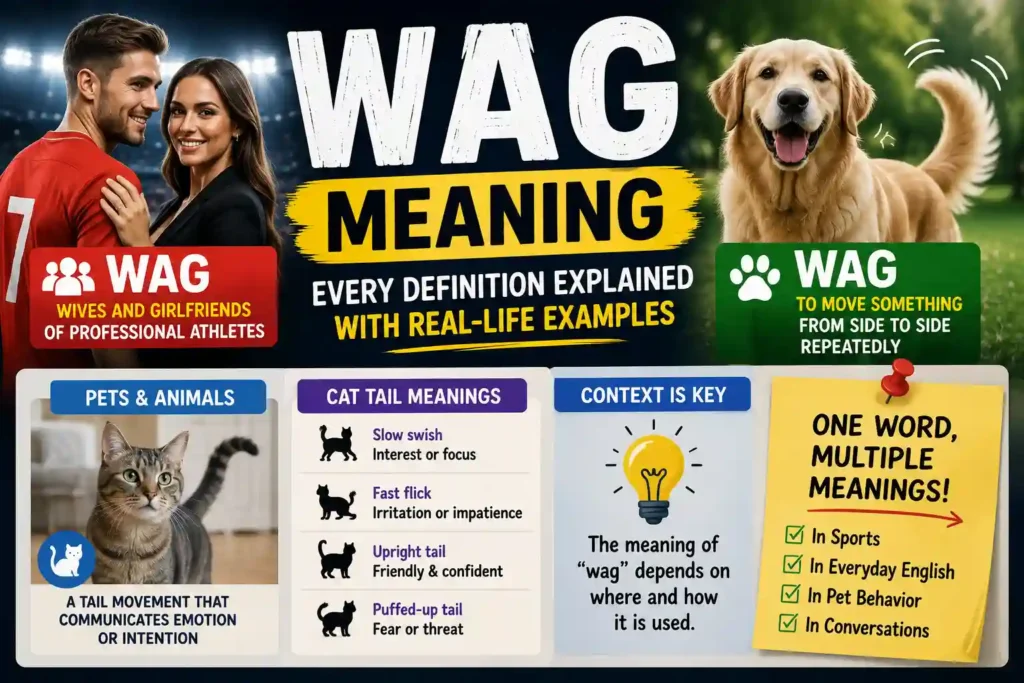
Wag Meaning at a Glance
| Where You See “WAG” | Meaning |
| Sports news and entertainment | Wives and Girlfriends of professional athletes |
| Everyday English | To move something from side to side repeatedly |
| Pet behavior | A tail movement that communicates emotion or intention |
| Conversation and media | The intended meaning depends on the context |
What Does Wag Mean?
The wag meaning isn’t limited to one definition. In English, the word works in several ways, and the surrounding context usually makes the intended meaning obvious.
Most commonly, wag can refer to:
- Moving a tail, finger, or head from side to side.
- WAG, an acronym used for the wives and girlfriends of professional athletes.
- Animal body language, especially when discussing dogs and cats.
For example, if someone says, “The puppy wagged its tail,” they’re describing movement. If a sports article mentions “famous WAGs,” it’s referring to the partners of well-known athletes rather than the action of wagging.
Understanding the setting is the easiest way to interpret the word correctly.
Explore related slang terms YN Meaning: 3 Common Definitions and How to Tell Them Apart
What Is a WAG in Sports?
If you’ve read football, soccer, cricket, or other sports coverage, you’ve probably seen the term WAG. In this context, it stands for Wives and Girlfriends of professional athletes.
The expression is commonly used by entertainment and sports media when discussing the partners of high-profile players. Some of these individuals attract significant public attention because of their careers in fashion, business, television, music, or social media, while others simply become well known through their relationship with an athlete.
Although the term first became widely associated with football, it is now used across many sports, including:
- Soccer
- American football
- Basketball
- Cricket
- Rugby
- Formula 1
Today, the label often appears in headlines covering major tournaments, championship events, red-carpet appearances, and celebrity news.
It’s important to remember that WAG describes a relationship to a professional athlete rather than a profession or achievement. Many people identified as WAGs have successful careers and accomplishments independent of their partners.
Browse related terminology What Does GNG Mean? Decode Its True Texting Meaning
Why Did the Term WAG Become Popular?
The acronym gained widespread attention during international football tournaments in the mid-2000s. News outlets began covering the families and partners of England’s national team players alongside the matches themselves.
As media interest grew, the abbreviation WAG became a convenient way to describe this group collectively. Over time, the term spread beyond football coverage and started appearing in articles about athletes from many different sports.
Today, it has become part of popular sports and entertainment vocabulary, even though its use varies between publications.
Discover similar internet slang POS Meaning Explained: What It Means in Text, Slang & Business
Is Calling Someone a WAG Positive or Negative?
Whether the label is viewed positively depends on the individual and the situation.
Some people use WAG as a neutral description because it’s widely recognized in sports journalism. In that sense, it’s simply a convenient way to identify the partner of a professional athlete.
Others dislike the term because it can reduce someone to their relationship instead of recognizing their own career, education, or achievements. Many partners of athletes are entrepreneurs, business owners, presenters, models, doctors, lawyers, or creators with successful careers that have nothing to do with sports.
For this reason, modern reporting often uses the term more carefully than it did in the past. Many publications now prefer mentioning a person’s name and profession before referring to their connection with an athlete.
Rather than assuming the label reflects someone’s identity, it’s more accurate to see it as a piece of sports and entertainment terminology whose meaning depends on context.
Wag as a Verb: The Dictionary Meaning
Outside of sports and popular culture, wag is most often used as a verb. It describes a repeated side-to-side movement, usually made to communicate, react, or express emotion.
The movement is typically quick and rhythmic rather than a single motion. People use the word for both humans and animals in everyday conversation.
Here are a few common examples:
- The dog wagged its tail as soon as its owner arrived home.
- She wagged her finger to signal that the children should stop arguing.
- He wagged his head in disagreement without saying a word.
Although the movement itself is simple, its purpose changes with the situation. A wagging finger can be a warning, while a wagging tail may show excitement or curiosity.
Read more slang guides ASL Meaning Slang: What Does ASL Mean in Text and Online Chats?
What Does It Mean When Cats Wag Their Tail?
Many people associate a wagging tail with happy dogs, but cats communicate differently. That’s why the answer to what does it mean when cats wag their tail isn’t always straightforward.
A cat’s tail acts as part of its body language. The speed, direction, and intensity of the movement all provide clues about how the cat feels at that moment. Looking at the tail alone, however, can lead to the wrong conclusion. The cat’s ears, eyes, posture, and surroundings should also be considered.
Some tail movements indicate curiosity or intense focus, while others signal irritation or overstimulation. Understanding these differences makes it easier to respond appropriately instead of misreading the cat’s mood.
Common Cat Tail Movements and Their Meanings
| Tail Movement | What It Often Indicates |
| Slow side-to-side swish | Watching something with interest or concentrating |
| Fast flicking | Frustration, irritation, or growing impatience |
| Gentle tip twitch | Alertness, curiosity, or playful excitement |
| Tail wrapped around the body | Relaxed, resting, or seeking comfort |
| Puffed-up tail | Fear, surprise, or feeling threatened |
| Upright tail with a slight curve | Friendly greeting and confidence |
These signals aren’t universal. A cat’s environment and personality also influence how its body language should be interpreted.
What Does a Cat Wagging His Tail Mean Around People?
The answer to what does a cat wagging his tail mean often depends on what is happening at that exact moment.
During Petting
If a cat begins flicking or swishing its tail while being stroked, it may be approaching its comfort limit. Continuing to pet the cat after these signals can sometimes lead to scratching or biting.
While Watching Something
A slowly moving tail often appears when a cat is tracking a bird outside the window, following a toy, or preparing to pounce. In these situations, the movement reflects concentration rather than annoyance.
During Play
Play sessions frequently involve quick tail movements as excitement increases. A playful posture, relaxed ears, and active engagement usually indicate the cat is enjoying the interaction.
When Meeting Someone
Some cats hold their tails upright with a slight curve while approaching familiar people. This posture is commonly viewed as a friendly greeting and a sign that the cat feels comfortable.
When Feeling Stressed
Rapid tail whipping combined with flattened ears, a tense body, or enlarged pupils can suggest the cat wants more personal space. Giving the animal time to settle is often the best response.
Instead of focusing on one movement, observe the cat’s entire body language. Multiple signals together provide a much clearer picture of its emotional state than the tail alone.
Explore Related Slang Terms What Does WYLL Mean? Surprising Text & Snapchat Slang Guide
Wag vs. Dog Tail Wagging: What’s the Difference?
Although both animals move their tails, the message behind the motion isn’t always the same.
| Dogs | Cats |
| Often wag when greeting people | May swish their tails while observing something |
| Frequently show excitement through broad tail movements | Commonly use tail motion to express changing emotions |
| Tail wagging is often linked with social interaction | Tail movement is one part of a broader communication system |
| Relaxed body language usually accompanies a friendly wag | The meaning depends on posture, ears, eyes, and the situation |
Because dogs and cats communicate differently, it’s best not to assume the same tail movement carries the same meaning. Reading the entire body language provides a more accurate understanding of what the animal is trying to communicate.
Examples of Wag in Everyday Sentences
Seeing the word in context is one of the easiest ways to understand how it’s being used. These examples show different meanings without relying on the same situation every time.
Everyday English
- The little girl wagged her finger after hearing the joke.
- He wagged his head to show he wasn’t interested.
- The horse wagged its tail to brush away flies.
- The puppy started wagging as soon as the gate opened.
- The child laughed while wagging a toy back and forth.
Sports and Entertainment
- Several well-known WAGs attended the championship celebration.
- The magazine featured interviews with athletes and their partners.
- Media coverage often focuses on famous couples during major tournaments.
- She built a successful business long before people associated her with a professional athlete.
- The documentary explored how public attention affects sports families.
Love To Read More What Does Sigma Mean? Slang, Sigma Male & Social Media Guide
Conclusion
WAG meaning becomes clear once you consider the context. In everyday English, it describes a repeated side-to-side movement. In sports reporting, WAG refers to the wives and girlfriends of professional athletes. Conversations about pets introduce another use, where tail movement helps communicate an animal’s emotional state. Rather than assuming a single definition, focus on the subject of the sentence and the surrounding details. That simple approach makes it much easier to understand which meaning is intended.
Frequently Asked Questions
What does “wag” mean in slang?
In slang, WAG usually stands for Wives and Girlfriends of professional athletes, especially footballers. The term is commonly used in sports and entertainment media to refer to the partners of well-known players.
Why is a footballer’s wife called a WAG?
A footballer’s wife or partner may be called a WAG because the acronym stands for Wives and Girlfriends. The term became widely known after British media used it during major international football tournaments to describe the partners of England’s national team players.
What does a WAG wife stand for?
A WAG wife refers to the wife of a professional athlete. The acronym WAG means Wives and Girlfriends, so the phrase simply identifies someone who is married to a sports professional.
What is a WAG in Australian slang?
In Australian slang, wag has a different meaning from the sports acronym. It commonly means to skip school or leave school without permission. For example, someone might say they “wagged school” instead of attending classes.
What is WAG me?
WAG me isn’t a standard English expression. If someone says it online, the intended meaning depends on the conversation. In most cases, they’re referring to WAG (Wives and Girlfriends) or using the abbreviation in a playful or informal way rather than as a dictionary term.
What is a male WAG called?
There is no official male equivalent of WAG. Some people informally use terms like HABs (Husbands and Boyfriends) or simply refer to them as the partner, husband, or boyfriend of an athlete. These alternatives are much less common than WAG.