
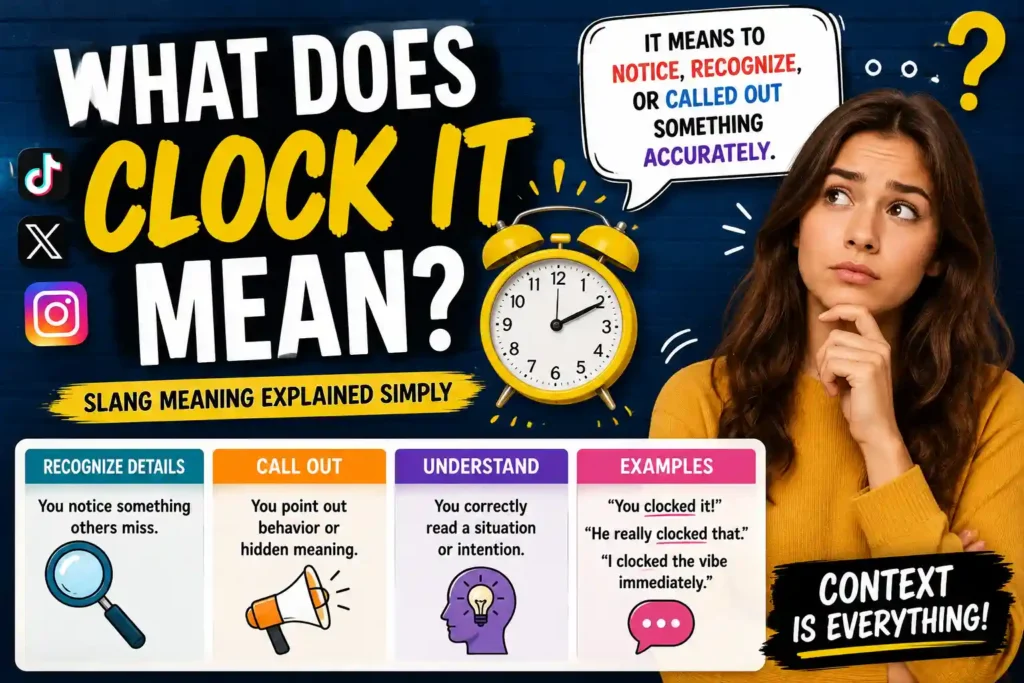
If you’ve seen someone comment “clock it” on TikTok, X, Instagram, or in a text conversation, you may have wondered, what does clock it mean? In modern slang, “clock it” means to notice, recognize, or accurately point out something that other people may have missed. It’s often used when someone correctly identifies a person’s behavior, intention, or an unspoken detail.
This slang meaning is different from the traditional verb “clock,” which can refer to measuring time or, in some contexts, striking someone. Online and in everyday conversations, “clock it” is about perception and awareness rather than time or physical action.
Clock It Meaning at a Glance
Here’s the short answer:
- Clock it means to notice, recognize, or call attention to something accurately.
- The phrase is commonly used when someone picks up on a detail, understands what’s really happening, or exposes something others didn’t immediately see.
- Depending on the situation, it can sound approving, neutral, playful, or slightly critical.
- You’ll most often encounter it on social media, in text messages, and casual conversations.
For example, if someone notices hidden sarcasm in a conversation that everyone else overlooked, another person might say they “clocked it.” The phrase highlights that they recognized something important before others did.
Explore Related Slang Terms Stud Meaning: Complete Guide to Slang, Text & Stud Muffin Meaning
How “Clock It” Is Used in Everyday Conversation
If you’re wondering what does clock it mean in everyday conversation, the phrase adapts to different situations. The core idea stays the same—recognizing something accurately—but what is being recognized can vary from one conversation to another.
Recognizing Something Others Miss
One of the most common uses of “clock it” is to acknowledge that someone noticed a subtle detail others failed to catch.
This could be:
- A change in someone’s attitude
- An inconsistency in a story
- A hidden joke
- A meaningful facial expression
- A subtle clue during a conversation
In these situations, saying someone “clocked it” means they were observant enough to pick up on something that wasn’t obvious at first glance.
Calling Out Behavior or Hidden Meaning
The phrase is also used when someone correctly identifies another person’s motives or behavior.
For instance, a person may recognize that someone is avoiding a question, exaggerating a story, or hinting at something without saying it directly. Saying they “clocked it” means they understood what was really going on beneath the surface.
This usage doesn’t always imply criticism. Sometimes it’s simply a way of acknowledging that someone understood the situation accurately.
Showing Someone Understood the Situation Correctly
In many conversations, “clock it” is used as a form of agreement or validation.
When another person makes an accurate observation, others may respond with phrases like:
- “You clocked it.”
- “She really clocked that.”
- “They clocked it immediately.”
These responses communicate that the observation was correct. Instead of introducing a new opinion, the speaker confirms that someone interpreted the situation accurately.
Because of this, the phrase often carries a sense of respect for someone’s awareness or attention to detail. It can also add humor or emphasis, especially in online discussions where users react to videos, trending topics, or viral moments.
Whether it’s spotting hidden meaning, recognizing unusual behavior, or understanding an unspoken message, “clock it” consistently revolves around one central idea: accurately noticing what others may not have seen at first.
Read more slang guides POS Meaning Explained: What It Means in Text, Slang & Business
What Does “Clocked It” Mean in Slang?
If you’re wondering what does clocked it mean slang, the phrase is simply the past-tense version of “clock it.” It means someone successfully noticed, recognized, or pointed out something accurately.
In other words:
- Clock it = notice or recognize something.
- Clocked it = noticed or recognized it.
The meaning stays the same, but “clocked it” refers to something that has already happened. People often use it after someone makes an accurate observation or correctly reads a situation.
For example, if a friend immediately realizes why someone is acting differently, another person might say they “clocked it.” The phrase acknowledges that their observation was correct.
Online, you may also see variations such as “she clocked it,” “he clocked that,” or “they clocked me.” Although the wording changes, the central idea remains recognizing something accurately or seeing through a situation.
Discover similar internet slang OG Meaning: What It Means in Text, Social Media & Slang
Why Context Changes the Meaning
While the core meaning of “clock it” rarely changes, the tone behind it can. The same phrase may sound complimentary, neutral, or critical depending on the conversation and the speaker’s intent.
Understanding that context helps you interpret the phrase correctly instead of assuming it always carries the same emotion.
Positive Recognition
Sometimes, “clock it” praises someone’s awareness.
When a person quickly notices an important detail or correctly understands a situation, saying they “clocked it” recognizes their perception. In this context, the phrase works as a compliment because it highlights someone’s attentiveness or insight.
Neutral Observation
In many conversations, the phrase is simply descriptive.
A person may “clock” a detail without judging it positively or negatively. They’re merely pointing out that they noticed something others may have overlooked. Here, the expression functions as an acknowledgment rather than praise or criticism.
Critical or Confrontational Use
The phrase can also become more pointed when someone exposes questionable behavior, identifies an inconsistency, or calls out hidden motives.
In these situations, “clock it” suggests that someone saw through the situation instead of accepting it at face value. Even then, the criticism comes from the surrounding conversation—not from the phrase itself.
This is why reading the full context is important. The words stay largely the same, but the speaker’s intention determines how they’re received.
Where You’re Most Likely to See “Clock It” Online
Although the phrase can appear in everyday conversations, it has become especially common on social media, where people react to videos, trending topics, celebrity moments, and online discussions.
TikTok
TikTok has helped popularize “clock it” among a wider audience. Users often leave the phrase in comments when a creator notices a subtle detail, explains a situation accurately, or points out something viewers may have missed.
Rather than repeating the entire explanation, commenters use “clock it” as a quick way to agree that someone understood what was really happening.
X (Twitter)
On X, the phrase frequently appears during discussions about news, entertainment, sports, and pop culture.
Users may say someone “clocked it” after they make an observation that later proves accurate or successfully identify the meaning behind a post, interview, or public statement.
Instagram comments use the phrase in much the same way. Whether reacting to a Reel, a Story, or a photo, people use “clock it” to acknowledge that someone recognized an important detail or interpreted a situation correctly.
Because comments are often short, the expression provides a concise way to show agreement without repeating the original point.
Text Messages and Group Chats
Outside social media, “clock it” also appears in text messages and group chats between friends.
It usually signals that someone understood a joke, noticed unusual behavior, or picked up on an unspoken message. Since everyone in the conversation already shares the context, the phrase feels natural and conversational without needing additional explanation.
Across all of these platforms, the meaning remains remarkably consistent. Whether you see it on TikTok, X, Instagram, or in a private chat, “clock it” almost always refers to recognizing or correctly calling out something that others may not have noticed immediately.
Learn more trending slang YN Meaning: 3 Common Definitions and How to Tell Them Apart
Where the Phrase Comes From
The modern slang use of “clock it” has roots in African American Vernacular English (AAVE) and later became widely recognized through ballroom culture, where sharp observation and quick wit were an important part of communication. Within these communities, the phrase was used to mean noticing, identifying, or calling attention to something accurately.
As social media platforms grew, the expression spread beyond its original communities. Short-form videos, memes, and online conversations introduced it to a much wider audience, especially on TikTok, X, and Instagram.
Today, many people use “clock it” without knowing its cultural background. Recognizing its origins provides helpful context and acknowledges the communities that popularized the expression long before it became mainstream internet slang.
How “Clock It” Differs From the Traditional Meaning of “Clock”
One reason people search what does clock it mean is that the word “clock” already has several established meanings in standard English.
Traditionally, clock can mean:
- To measure or record time.
- To record a speed or performance.
- In some informal contexts, to strike someone.
The slang phrase “clock it” is different. Instead of referring to time or physical action, it means to notice, recognize, or accurately identify something.
This distinction is important because the intended meaning depends entirely on context. If someone comments, “You clocked it,” they are almost certainly saying you made an accurate observation—not referring to timekeeping or physical contact.
Similar Slang Expressions You Might See
If you spend time on social media, you’ll notice several expressions that share a similar idea with “clock it.” While they all involve understanding or recognizing something, they are not exact synonyms.
- Call it out – openly point out behavior or a situation.
- Caught that – noticed an important detail.
- Picked up on it – understood something subtle or implied.
- Read the situation – correctly interpreted what was happening.
- Saw through it – recognized someone’s real intentions or motives.
Each expression has its own nuance, but they all revolve around awareness, observation, and understanding hidden meaning. Knowing these related phrases can make online conversations easier to follow.
Common Misunderstandings About “Clock It”
Several misconceptions surround this phrase because it has both traditional and slang meanings.
One common misunderstanding is thinking “clock it” always means criticizing someone. In reality, it can simply acknowledge that a person noticed something accurately. Whether the tone feels positive, neutral, or critical depends on the conversation.
Another misconception is that the phrase originated on TikTok. Although social media helped make it more popular, the expression existed long before it became part of mainstream internet culture.
Finally, some people confuse “clock it” with the standard English meanings of “clock.” In modern slang, the phrase is generally about observation and recognition rather than measuring time or physical action.
Conclusion
If you’ve been asking what does clock it mean, the short answer is that it’s a slang phrase used when someone notices, recognizes, or accurately points out something others may have missed. Whether you encounter it in a text message, on TikTok, X, Instagram, or in everyday conversation, the core meaning remains the same.
Understanding the surrounding context is the key to interpreting the phrase correctly. Once you know that “clock it” centers on perception and accurate observation, it’s much easier to understand why people use it across so many online and offline conversations.