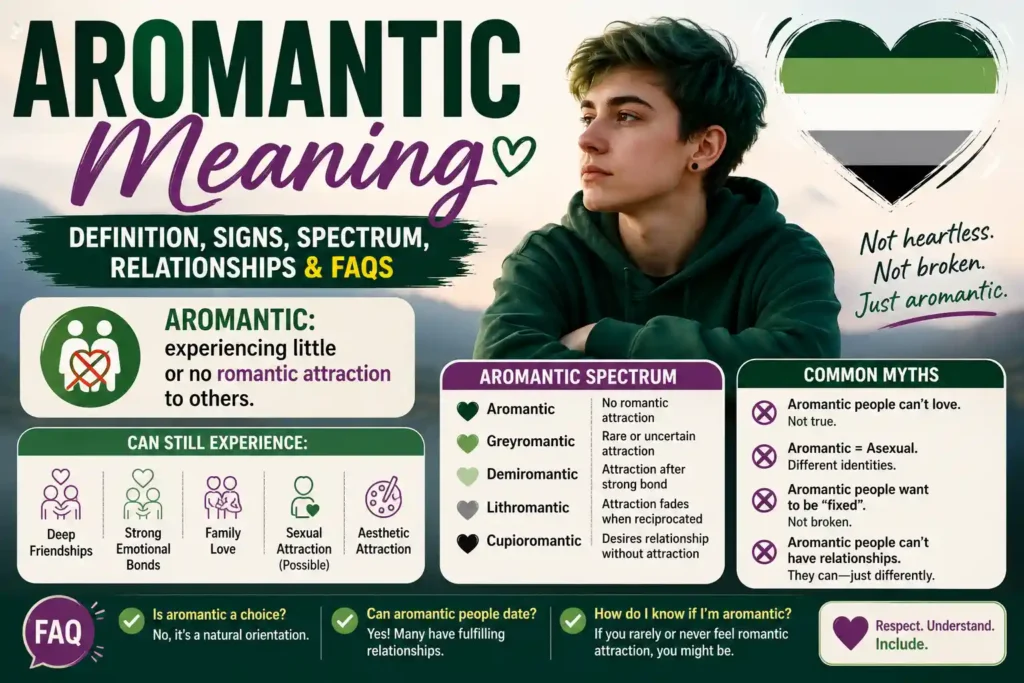
Aromantic meaning, at its core, describes someone who experiences little or no romantic attraction to others. It’s one of the most misunderstood terms in the LGBTQ+ vocabulary, mostly because people conflate romantic attraction with sexual attraction assuming that if you don’t want a boyfriend or girlfriend, you must not want sex either, or that if you enjoy physical intimacy, you must also want a relationship built around romance. Neither assumption holds. Aromanticism isn’t a single on/off switch either it exists on a spectrum, ranging from people who never experience romantic attraction to those who experience it rarely, conditionally, or only in specific circumstances.
What Does Aromantic Mean?
In simple terms, someone who is aromantic experiences little to no desire to form romantic relationships. That’s the whole definition nothing more is implied about their capacity for love, closeness, or intimacy.
The confusion almost always comes from treating “attraction” as one undifferentiated feeling. It isn’t. Romantic attraction the pull toward a specific person that makes someone want a relationship framed around romance, like dating, anniversaries, or a shared future as partners is only one type. Sexual attraction, physical attraction, and emotional attraction are separate systems that can move independently of each other. Someone can feel deep emotional closeness with a partner and no romantic pull at all, or feel sexual attraction without wanting the trappings of a romantic relationship.
Being aromantic is not a disorder, a deficiency, or a phase to be corrected. It isn’t listed as a mental health condition in any diagnostic manual, and mental health organizations that address it treat it the same way they treat any other orientation: as a normal variation in how humans experience attraction, not a symptom of something wrong. The same caution applies throughout this article nothing here should be read as implying aromantic people are missing something that needs fixing.
Aromantic Meaning in Simple Words
Here’s the plainest way to put it: some people feel a strong urge to fall in love and build their life around a romantic partner. Aromantic people generally don’t feel that urge or feel it so rarely or faintly that it doesn’t shape how they approach relationships.
A real-life example: imagine watching a friend get butterflies before a first date, replay a conversation with their crush for days, or feel their stomach drop when they see their partner across a room. An aromantic person can recognize that this is a real experience other people have they just don’t experience it themselves, the way someone who’s colorblind can understand that red and green look different to other people without being able to see the difference. That doesn’t stop them from loving their friends fiercely, caring deeply about family, or building a life full of meaningful connection it just means romance specifically isn’t part of how that connection shows up.
What Is Romantic Attraction (And How Is It Different From Other Kinds)?
Most confusion around aromanticism comes down to treating “attraction” as a single thing. Researchers and the aromantic/asexual community generally describe it as several separate channels, a framework often called the Split Attraction Model (SAM). It separates who or what someone is drawn to from what kind of pull it is which is exactly what makes it possible to be aromantic without being asexual, or asexual without being aromantic.
| Attraction Type | What It Involves |
| Romantic attraction | A desire to be in a romantic relationship with a specific person dating, partnership, romance-coded intimacy |
| Sexual attraction | A desire for sexual contact with a specific person |
| Emotional attraction | A pull toward deep emotional closeness and vulnerability with someone |
| Physical attraction | A response to someone’s physical presence, independent of sexual desire |
| Platonic attraction | A desire for a close friendship with someone, without romantic or sexual components |
| Aesthetic attraction | Appreciating how someone looks the way you’d appreciate art, with no desire for contact at all |
None of these require each other. A person can feel platonic and emotional attraction toward a close friend with zero romantic or sexual attraction involved. That’s the mechanism behind most aromantic experience: the other attraction types can still be fully present.
Aromantic vs Asexual
These two get merged constantly, largely because both fall under the “little to no attraction” umbrella and both are commonly abbreviated with “a-” (aro / ace). But they describe different systems.
| Aromantic | Asexual | |
| What’s affected | Romantic attraction | Sexual attraction |
| Can still want/have sex | Yes many aromantic people enjoy and pursue sex | Not the focus this is specifically about romance, which asexual people can still want |
| Can still want romance | Not the focus this is specifically about sex, which aromantic people generally don’t seek | Yes many asexual people date, fall in love, and want romantic partnerships |
| Exists on a spectrum | Yes (arospec) | Yes (acespec) |
| Relationship to each other | Independent identities a person can be one, both, or neither | Independent identities a person can be one, both, or neither |
Someone who is both aromantic and asexual is often described as aroace. But plenty of aromantic people are not asexual (they may want and enjoy sex without wanting romance), and plenty of asexual people are not aromantic (they may want romantic partnership without wanting sex). Treating the two as synonyms erases both groups’ actual experience.
Can Aromantic People Fall in Love?
Yes the confusion here is assuming “love” only means romantic love. Aromantic people can and do experience:
- Family love the bond with parents, siblings, or children, which was never romantic to begin with for anyone
- Friendship love platonic closeness that can be as central to someone’s life as a marriage is to someone else’s
- Queerplatonic relationships committed, high-priority partnerships that aren’t romantic but go beyond typical friendship in commitment level, and sometimes include living together, shared finances, or raising children together
- Life partnerships long-term companionship built on shared goals and mutual care rather than romantic attraction
The common thread: romantic attraction is one specific type of bond, not a stand-in for depth of feeling. An aromantic person’s friendship or family bond isn’t a consolation prize for romance they can’t feel it’s simply where their capacity for deep attachment goes.
Signs You Might Be Aromantic
These are patterns people in the aromantic community commonly describe recognizing in themselves not a diagnostic checklist, and not something a doctor or therapist would ever “test” for. Romantic attraction isn’t measurable from the outside, so the only real signal is your own repeated experience over time. People sometimes relate to:
- Never having had a romantic crush, or being unsure they’ve ever felt one, while peers seem to have them constantly
- Not looking forward to dating, or finding the process draining rather than exciting
- Romantic gestures (grand declarations, anniversaries, “relationship milestones”) feeling performative or unnecessary rather than meaningful
- Preferring the depth of close friendships over pursuing a romantic partner
- Struggling to relate to romance-driven plots in movies or books, even when the rest of the story lands fine
- Feeling genuinely content not lonely or “missing out” without a romantic relationship
Recognizing one or two of these isn’t proof of anything; plenty of alloromantic (non-aromantic) people also dislike dating or find rom-coms tedious. What tends to distinguish an aromantic experience is the combination, and the absence of romantic attraction itself rather than just disinterest in its trappings.
Aromantic Spectrum
Aromanticism isn’t binary it’s an umbrella (often called arospec) covering people whose experience of romantic attraction is limited, conditional, or unusual in some way, rather than fully absent. These identities are more specific labels people use to describe their own experience not required categories.
- Grayromantic (or greyromantic) experiences romantic attraction rarely, faintly, or under limited circumstances; sits between romantic and aromantic
- Demiromantic doesn’t experience romantic attraction until a strong emotional bond has already formed with someone
- Lithromantic (also called akoiromantic) can feel romantic attraction, but doesn’t want it reciprocated; the feeling can fade if the other person reciprocates it
- Frayromantic feels romantic attraction toward people they don’t know well, which fades once a real emotional bond forms roughly the opposite pattern from demiromantic
- Cupioromantic doesn’t experience romantic attraction, but still desires a romantic relationship
- Recipromantic (reciproromantic) only experiences romantic attraction toward someone once they know that person is already attracted to them
- Aegoromantic (autochorisromantic) enjoys the idea of romance in the abstract (in fiction, for instance) but feels no personal desire to participate in it themselves
| Identity | Core Pattern |
| Grayromantic | Romantic attraction, but rare or faint |
| Demiromantic | Attraction only after a strong bond forms |
| Lithromantic | Attraction fades if reciprocated |
| Frayromantic | Attraction fades once a bond forms |
| Cupioromantic | No attraction, but wants a relationship |
| Recipromantic | Attraction only if it’s already reciprocated |
| Aegoromantic | Likes the idea of romance, not living it |
The full list of arospec microlabels is longer than this advocacy groups like AUREA (the Aromantic-spectrum Union for Recognition, Education, and Advocacy) maintain more exhaustive glossaries but these seven are the ones people search for and encounter most often.
Can Aromantic People Date?
Yes. Aromanticism describes attraction, not behavior, and the two don’t always move together. Within the community:
- Some date anyway for companionship, social expectation, curiosity, or because they’re cupioromantic and specifically want the relationship structure without the attraction driving it
- Some marry often to a partner who understands their orientation, sometimes in a queerplatonic arrangement rather than a conventionally romantic one
- Some have children parenting isn’t contingent on romantic attraction toward a co-parent
- Some prefer friendship-based partnerships prioritizing a platonic life partner over a romantic one
- Some don’t pursue any of it and are simply not seeking a relationship at all
There’s no “more valid” option on that list. What matters is that the choice is actually the person’s own, not something assumed on their behalf either way not “they must want a normal relationship really” and not “they must want nothing.”
Can Aromantic People Have Sex?
Yes, for many. This is the single most common misunderstanding about the term: aromantic is not a synonym for asexual. Romantic attraction and sexual attraction are separate systems (see the Split Attraction Model above), which means:
- Some aromantic people enjoy sex and actively pursue it, entirely apart from any romantic feeling
- Some aromantic people are also asexual and aren’t interested in sex either but this is a second, independent identity (aroace), not something implied by aromanticism alone
- Sexual orientation (who someone is sexually attracted to, or whether they experience sexual attraction at all) is tracked completely separately from romantic orientation
Assuming an aromantic person doesn’t want sex or, in the other direction, assuming their sex life proves they’re “not really” aromantic misreads what the term is actually describing.
Common Misconceptions About Aromanticism
| Myth | Reality |
| Aromantic people can’t love | False they experience family, platonic, and queerplatonic love; what’s absent is specifically romantic attraction |
| They hate relationships | False many value friendship, family, and queerplatonic bonds as highly as anyone values a marriage |
| It’s a phase | Not necessarily for most people who identify this way, it’s a stable, lasting orientation, though (as with any orientation) some people’s understanding of their own attraction shifts over time |
| They’re emotionally cold | False absence of romantic attraction says nothing about someone’s emotional depth or capacity for empathy |
| They need fixing | False aromanticism isn’t a disorder, and there’s no “correct” amount of romantic attraction a person is supposed to feel |
Challenges Aromantic People May Face
- Social pressure a culture that treats romantic partnership as the default life milestone can make aromantic people feel like they’re constantly explaining a “gap” that isn’t actually missing anything
- Dating expectations friends, apps, and family often assume romance is the goal of any close relationship, which can put aromantic people in the position of correcting that assumption repeatedly
- Family misunderstanding parents or relatives may interpret aromanticism as “not having met the right person yet” rather than as a stable orientation
- Thin representation romantic plots dominate film, TV, and books to the point that aromantic audiences rarely see relationship models that reflect their own experience, which can make the identity harder to recognize in oneself in the first place
How to Support Someone Who Is Aromantic
- Respect the identity take it at face value rather than treating it as a puzzle to solve or a phase to wait out
- Avoid assumptions don’t assume they’re lonely, don’t assume they secretly want a partner, and don’t assume their friendships are a substitute for “something more”
- Don’t pressure dating skip the “you just haven’t met the right person” line; it reframes their stated experience as a temporary problem
- Accept different relationship goals a queerplatonic partnership or a friendship-centered life is a complete, valid outcome, not a fallback
- Listen without judgment if they’re explaining their experience to you, the most useful response is usually just believing them
Conclusion
Aromanticism describes how someone experiences romantic attraction not their capacity to care deeply about the people in their life. Someone who is aromantic can still build a life full of close friendship, family closeness, and committed partnership; what’s different is simply that romance specifically isn’t the attraction driving it. As with any orientation, there’s no single “correct” way to form meaningful relationships, and understanding the term is mostly a matter of separating romantic attraction from every other kind of connection it’s routinely and wrongly bundled with.
Frequently Asked Questions
What does aromantic mean?
An aromantic person experiences little to no romantic attraction toward others. This doesn’t affect their ability to care deeply for friends, family, or partners, and it is separate from sexual orientation.
Can aromantic people have relationships?
Yes. Aromantic people can build meaningful relationships through close friendships, family connections, queerplatonic partnerships, or even romantic relationships if they choose. Relationship preferences vary from person to person.
Is aromantic the same as asexual?
No. Aromanticism relates to romantic attraction, while asexuality refers to sexual attraction. A person can be aromantic, asexual, both (often called aroace), or neither.
Can aromantic people marry?
Yes. Some aromantic people choose to marry for companionship, shared life goals, or a committed partnership, while others prefer different types of long-term relationships or remain single. Marriage is a personal choice, not a reflection of romantic attraction.
Can someone become aromantic?
Most aromantic people describe it as a natural and lasting romantic orientation rather than something that develops later in life. However, personal understanding of romantic attraction can change over time as people learn more about themselves.
Is aromantic part of LGBTQ+?
Yes. Aromantic identities are widely recognized as part of the LGBTQ+ community because they differ from traditional expectations of romantic attraction. Many LGBTQ+ organizations include aromantic and asexual-spectrum identities under the broader umbrella.
Can aromantic people have crushes?
It depends on where someone falls on the aromantic spectrum. For example, grayromantic or demiromantic people may experience romantic attraction rarely or only under certain circumstances, while many aromantic people do not experience romantic crushes at all.
Can aromantic people love someone?
Absolutely. Aromantic people can experience deep love through friendships, family relationships, and queerplatonic partnerships. A lack of romantic attraction does not reduce a person’s ability to form meaningful emotional bonds.
How do I know if I’m aromantic?
If you consistently feel little or no desire for romantic relationships despite wanting companionship, friendship, or emotional closeness, you may identify with the aromantic spectrum. Exploring aromantic experiences and reflecting on your feelings can help you decide whether the label fits.
Is aromanticism rare?
Research on aromanticism is still limited, so exact numbers are unknown. Current studies suggest aromantic identities are relatively uncommon in the general population, but awareness has increased in recent years, allowing more people to recognize and accurately describe their experiences.