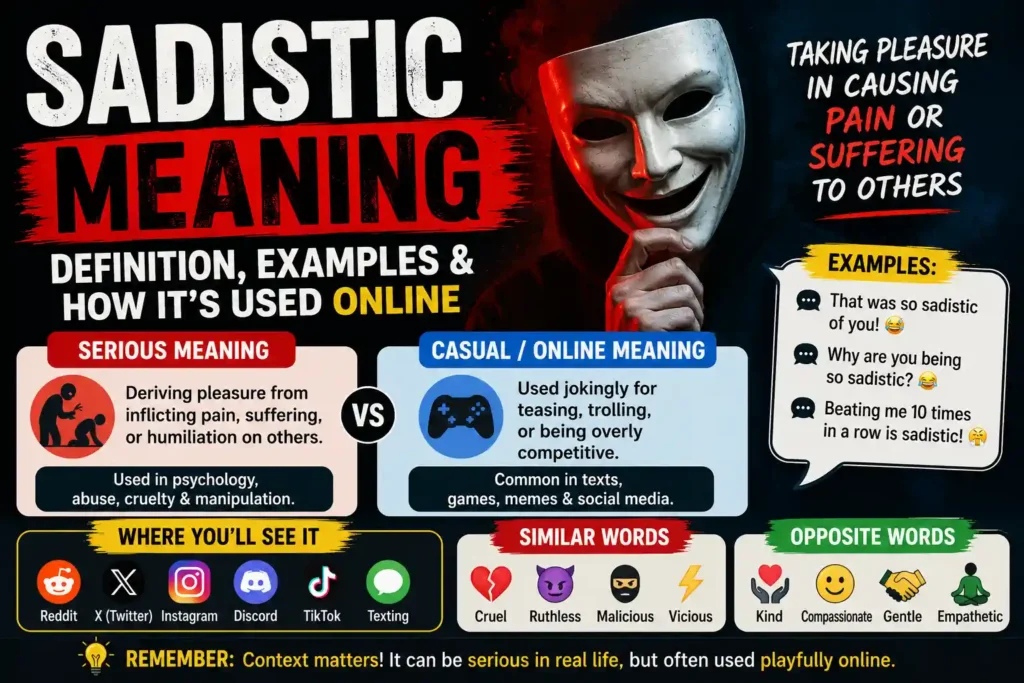
The sadistic meaning most people are searching for describes someone who takes pleasure in causing pain physical or emotional rather than just causing it by accident. But online, the word rarely carries that heavy, clinical weight anymore.
These days, “sadistic” gets thrown around for things like a friend beating you at Mario Kart for the tenth time in a row. That’s the tricky part: this word has a real psychological definition and a much more casual, exaggerated meaning that’s taken over texting and social media. Which one applies depends entirely on context. Below, you’ll find both meanings explained, where the word came from, real examples of how it’s used, and when it should and shouldn’t be used as a joke.
Quick Answer
In its true sense, sadistic describes someone who enjoys inflicting pain, suffering, or humiliation on others not just causing harm, but getting satisfaction from it. Casually, especially online, people use it for someone who’s a little too competitive, blunt, or teasing, with no real cruelty behind it at all.
Sadistic Meaning at a Glance
| Word | Meaning | Part of Speech | Tone | Common Uses | Opposite |
| Sadistic | Taking pleasure in causing pain or suffering to others | Adjective | Serious (literal) / Playful (casual) | Describing cruelty, abuse, or joking about teasing and competitiveness | Compassionate |
What Does Sadistic Mean?
Dictionaries describe sadistic as deriving pleasure sometimes sexual, sometimes purely psychological from inflicting pain or humiliation on someone else. That’s the literal meaning, and it’s more specific than most people assume.
Here’s the key distinction: causing pain isn’t automatically sadistic. A surgeon causes pain. A tough coach pushes people past their comfort zone. What makes an act sadistic is the enjoyment behind it the person isn’t just tolerating someone else’s suffering, they’re getting something out of it.
That pain doesn’t have to be physical, either. Someone who manipulates a partner’s insecurities for fun, or mocks a coworker’s mistakes just to watch them squirm, is behaving sadistically without touching anyone. Intention is what separates this from cruelty that’s careless or accidental.
Love To Read More Wag Meaning: Every Definition Explained with Real-Life Examples
The Origin of the Word “Sadistic”
The word traces back to the Marquis de Sade, an 18th-century French writer whose work described violent, controlling scenarios. In the 1800s, psychiatrists coined “sadism” using his name to describe a pattern of enjoying others’ pain.
“Sadistic” followed soon after as the adjective form. Knowing this origin matters because it explains why the word carries so much weight clinically it was never meant to describe mild meanness, only genuine pleasure taken in someone else’s suffering.
Read more slang guides What Does Clock It Mean? Slang Meaning Explained Simply
How Is “Sadistic” Used Today?
Once you understand the core sadistic meaning, it’s clear why context does most of the work. The same word can describe a violent abuser or a friend being dramatic after winning a board game.
Serious Meaning
In serious contexts, sadistic keeps its full weight, describing:
- Cruelty toward people or animals
- Abuse involving deliberate humiliation or control
- Manipulation designed to make someone suffer
- Bullying that targets someone’s weaknesses on purpose
- Emotional harm inflicted for the abuser’s own satisfaction
Here, the word isn’t an exaggeration it’s describing real harm from someone who enjoys the power involved.
Casual Everyday Meaning
Among friends and online, the word gets stretched well past its clinical roots. People use it for:
- A sibling who won’t drop a small, annoying joke
- A prank that went a little too far
- A friend who trash-talks you mid-game
- Someone brutally competitive over something low-stakes
- Playful jabs between close friends
Nobody actually thinks their gaming buddy is a clinical sadist. The exaggeration is the point it’s meant to sound dramatic, not accurate.
Learn more trending slang DTM Meaning Explained: Complete Guide to Text, IOM & GIS
Sadistic Meaning in Texting and Social Media
On TikTok, Instagram, X, Reddit, Discord, and Snapchat, “sadistic” shows up constantly almost never in its clinical sense. A TikTok comment might read: “the way she paused before roasting me was actually sadistic 💀.” In a group chat: “you waiting until I finished talking just to say no is SO sadistic.”
Gen Z leans on dramatic, oversized language because it’s more entertaining than saying “that was kind of mean.” Calling something sadistic adds humor through overstatement the bigger the word, the funnier the reaction.
Context still rules, though. A comment describing genuine harassment or abuse online isn’t casual it means exactly what it says.
Browse related terminology Snow Bunny Meaning: Simple Guide to Every Common Definition
Examples of “Sadistic” in Conversations
Texting between friends:
Mia: “why would you send that meme right when I was eating 💀” Jade: “ngl that was kind of sadistic of me lol”
Siblings:
Older brother: “I ate the last slice knowing you wanted it” Younger sister: “that’s actually sadistic, you know that right”
Gaming:
Player 1: “bro camped my spawn for 10 minutes straight” Player 2: “that’s sadistic behavior ngl”
Group project at school:
Student A: “she waited until the deadline to tell us the slides were wrong” Student B: “that’s kind of sadistic honestly”
Different Meanings at a Glance
| Level | Meaning | Example |
| Psychology | Genuine pleasure from causing pain | Clinical diagnosis, abusive behavior |
| Everyday serious use | Deliberate cruelty in real situations | Workplace bullying, manipulation |
| Internet slang | Exaggerated teasing or competitiveness | “That roast was sadistic” |
| Memes | Pure humor, no real meaning attached | Joking captions, reaction posts |
Context moves the word up or down this scale. The same sentence can be a joke between friends or a genuine warning sign, depending on who’s saying it and why.
Read More CTFU Meaning: What It Means in Text & Social Media
Similar Words and How They’re Different
- Cruel general harm, without requiring enjoyment. Use when you’re not sure the person is getting satisfaction from it.
- Ruthless lack of mercy tied to ambition or decisions, not pleasure. Better for a boss or competitor.
- Savage blunt or fierce, often used casually online, but less specific about enjoyment.
- Diabolical implies scheming or wickedness; about the plan more than the pleasure.
- Unhinged unpredictable or unstable, not necessarily cruel.
- Menace threatening or dangerous overall, more about vibe than intent.
“Sadistic” is the right word specifically when enjoyment of someone else’s pain is the defining trait.
Synonyms and Antonyms
Synonyms: Cruel, Heartless, Ruthless, Malicious Antonyms: Compassionate, Kind, Gentle, Empathetic
These are close relatives, not perfect substitutes each carries its own shade of meaning.
How to Respond When Someone Calls You “Sadistic”
A few playful replies, for friendly situations only:
- “Only for you 😌”
- “It’s a gift, honestly”
- “I prefer ‘chaotic good'”
Example:
Friend: “you’re actually sadistic for laughing at that” You: “it’s called comedic timing”
These lines work among friends joking around. They’re not appropriate for a serious accusation.
Common Mistakes People Make
- Thinking sadistic just means “mean” it specifically implies enjoyment of pain, not general unkindness.
- Assuming every online use is literal most modern uses are exaggerated for effect.
- Using it casually around real abuse this can trivialize genuine harm.
- Confusing “sadist” with “sadistic” a sadist is the person; sadistic describes the trait or behavior.
- Ignoring context the same sentence can mean two completely different things.
When You Should Avoid Using the Word
Some situations call for precise language, not casual exaggeration. Avoid using “sadistic” lightly when discussing:
- Domestic violence or abusive relationships
- Bullying that causes real emotional harm
- Animal cruelty
- Criminal behavior involving intentional harm
In these cases, the word describes documented psychological patterns. Using it loosely can minimize what victims actually experienced precise language matters most exactly when the stakes are highest.
Conclusion
At its core, the sadistic meaning describes someone who enjoys causing pain not just tolerating it, but getting satisfaction from it. That’s the serious, clinical definition. Online, the word gets stretched into something lighter: dramatic teasing, competitive trash-talk, or exaggerated reactions to harmless situations.
The difference always comes down to context. If someone’s joking about a game or a sibling’s antics, there’s nothing to worry about. But if the word comes up around real cruelty, abuse, or manipulation, take it seriously in those situations, it means exactly what it says.
Frequently Asked Questions
What is the sadistic meaning?
Sadistic meaning refers to taking pleasure in causing someone else pain, fear, or humiliation. Online, the word is also used jokingly for harmless teasing or exaggerated behavior.
What does sadistic mean?
Sadistic describes a person or behavior that enjoys causing physical or emotional suffering. The key idea is finding satisfaction in another person’s discomfort.
Is calling someone sadistic always an insult?
No. Among friends, it’s often used as a playful exaggeration. In serious situations involving abuse or cruelty, it’s a genuine accusation.
Can someone be sadistic without physical violence?
Yes. Emotional manipulation, humiliation, or psychological cruelty can also be described as sadistic when someone enjoys causing that distress.
What’s the difference between sadist and sadistic?
A sadist is the person, while sadistic describes the person’s behavior or traits. One is a noun, and the other is an adjective.
Is sadistic a psychological term?
Yes. The term comes from psychology and describes pleasure derived from another person’s suffering. It has also become common in everyday language and online conversations.
Can “sadistic” be used jokingly online?
Yes. People often use it humorously on social media or in group chats to describe harmless teasing, pranks, or competitive behavior.
Where did the word sadistic come from?
The word comes from the Marquis de Sade, whose name inspired the term sadism. Later, sadistic became the adjective used to describe that behavior.